Key takeaways
- The EU's July 16, 2026 ruling forces Google to share anonymized search data with rivals like OpenAI by January 2027 under Article 6(11) of the Digital Markets Act.
- Google must open Android to rival AI assistants by July 2027, granting them the same deep system access currently enjoyed by Gemini.
- ChatGPT surpassed 1 billion monthly active users in June 2026, while Google's EU search volume dropped 8% year-over-year in May 2026 due to AI tool adoption.
- Non-compliance with the DMA carries fines of up to 10% of global annual turnover, potentially costing Alphabet over $30 billion.
- The ruling establishes data sharing as a preventive ex-ante regulation, moving away from the ex-post antitrust fines that failed to curb Google's 91.25% search market share.
On July 16, 2026, the European Commission dropped a regulatory bomb on Google, finalizing rules that require the company to share its search data with rivals and open its Android operating system to competing AI assistants. The directive, enforced under the Digital Markets Act (DMA), mandates that Google hand over anonymized search data to third-party search engines and AI chatbot providers like OpenAI. The verdict fundamentally alters the architecture of the internet by legally decoupling Google's massive data advantage from its own products.
For the average internet user, this sounds like a distant bureaucratic dispute in Brussels. It is not. The decision directly dictates how the AI tools you rely on every day—ChatGPT, Perplexity, Claude, and whatever comes next—will evolve over the next two years. Google currently processes over 8.5 billion searches daily, giving it an unmatched, real-time view of human intent and knowledge. By forcing the company to share that data under Article 6(11) of the DMA, the EU is attempting to permanently alter the competitive landscape of the AI arms race.
The Demolition of the Data Moat
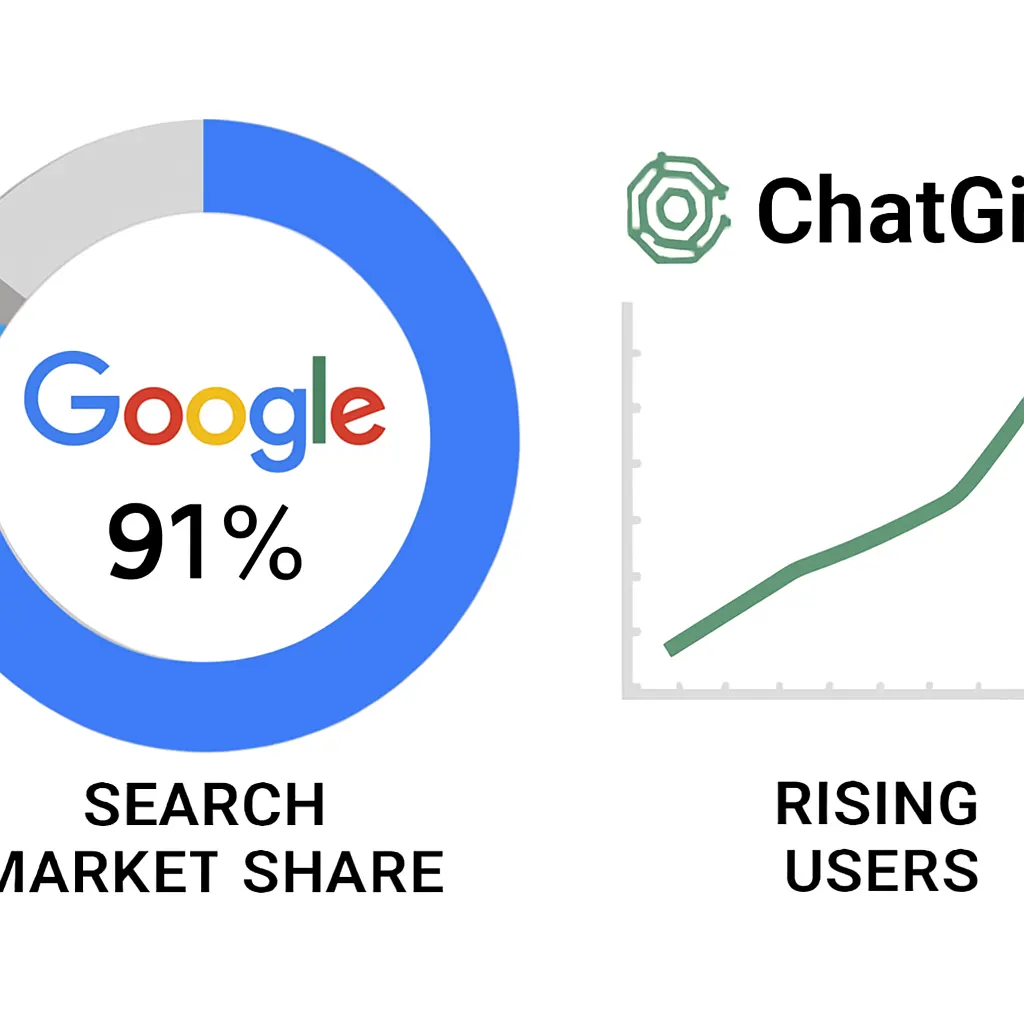
For two decades, Google’s supremacy has been built on a compounding cycle: more users generate more search queries, which generate more data, which trains better algorithms, which in turn attracts more users. As of early 2026, Google maintains a 91.25% share of the global search engine market across all devices, according to Statcounter. Bing sits at a distant 4.68%.
However, traditional search market share only tells half the story. ChatGPT officially crossed 1 billion global monthly active users in June 2026, becoming the fastest application in history to hit that milestone. This massive user base is fundamentally changing how people seek information, heavily impacting Google's core business. In May 2026, Reuters reported that Google's overall search volume in the EU experienced its first year-over-year decline since 2015, dropping by 8%—a direct result of users pivoting to generative AI tools for complex queries. EU regulators recognized this shift and moved aggressively to prevent Google from using its legacy search dominance to monopolize the emerging AI sector.
The EU Commission's July 16 guidance is highly specific. Under Article 6(11) of the DMA, Google is required to provide competitors with free, anonymized access to its search data, including clicks, queries, and results. The directive specifies that the data shared must be of sufficient quality and granularity that rival AI models can actually use it to optimize their own services. The Commission also addressed mobile integration: Google must allow rival AI agents on Android devices the same deep system access currently enjoyed by its own Gemini assistant. Under the compliance timeline, Google must begin sharing search data with rivals by January 2027, and Android must be fully opened to competing AI assistants by July 2027.
What This Means for Your AI Tools
Right now, AI tools face a massive information deficit. While OpenAI and Anthropic train their models on vast amounts of text scraped from the open web, they lack continuous, real-time data regarding how humans actually formulate questions and evaluate answers. Search query data is the ultimate map of human curiosity and confusion. When Google shares this data, competing AI models will gain an unprecedented ability to understand edge-case queries, trending topics, and user intent.
For consumers, the immediate impact will manifest in two distinct ways. First, the accuracy of rival AI chatbots will spike. An AI model trained on Google's search data will better understand the context of your prompts, leading to more relevant and precise responses. Second, you will likely see deep integration of rival AI tools into your smartphone's operating system. Currently, if you ask an Android device to book a table or summarize a webpage, Gemini handles the task. By July 2027, the EU mandate dictates you could seamlessly replace Gemini with ChatGPT or Claude, with those assistants possessing the exact same underlying system access.
However, this level of integration introduces friction. A January 2026 report by the tech trade group Chamber of Progress highlighted significant privacy concerns regarding how third parties will handle anonymized search data. The report noted that while names and IP addresses are stripped, the granular nature of search queries makes true anonymization mathematically difficult. A sequence of hyper-specific queries about local businesses, medical conditions, or niche hobbies can easily be reverse-engineered to identify an individual.

Google's Aggressive Pushback
Unsurprisingly, Google has mounted a fierce defense against the EU's mandates, framing the directives as a profound threat to user privacy and product viability. In a statement responding to the Commission, Google argued that the required data sharing introduces “unprecedented risks” to user security by potentially exposing sensitive search histories to third parties. The company contends that forcing them to hand over the data that powers their core business amounts to a regulatory overreach that stifles innovation.
Google's legal battles over the DMA have been relentless. The company has repeatedly challenged the legality of DMA obligations in European courts. A pivotal moment occurred on July 8, 2026, when the EU General Court ruled that designated gatekeepers cannot seek judicial review of DMA obligations before complying with them. This stripped Google of its primary legal stall tactic, forcing the company to implement the changes while continuing to litigate.
The financial stakes are astronomical. Under the DMA framework, non-compliance can result in fines of up to 10% of a company’s global annual turnover. For Alphabet, Google's parent company, that translates to a potential penalty exceeding $30 billion based on 2025 revenues. In May 2026, Reuters reported that the European Commission was preparing a record DMA fine against Google—reportedly in the “high triple-digit million euro” range—over previous search self-preferencing violations. The new data-sharing directive ups the ante considerably.
The Historical Context: Why Brussels Intervened
For readers who have followed Big Tech's regulatory troubles, the EU’s July 2026 mandate is the culmination of a 15-year battle against Google's market dominance. Brussels has spent the better part of a decade attempting to curb Google's power, resulting in over €8 billion in antitrust fines between 2017 and 2019 for abuses related to Google Shopping, Android, and AdSense.
HISTORICAL CONTEXT: Those previous efforts largely failed to change Google's market position. The company simply paid the fines and tweaked its algorithms slightly, maintaining its iron grip on the search market. The DMA represents a paradigm shift in regulatory philosophy. Instead of imposing ex-post fines for bad behavior, the DMA establishes ex-ante rules—preventive regulations that dictate how gatekeeper platforms must operate before any anticompetitive harm occurs. The EU recognized that in the age of AI, waiting five years to litigate an antitrust case is effectively a death sentence for competition.
The Geopolitical Ripple Effect
The EU's decision will not stay confined to European borders. The Digital Markets Act has already established a Brussels Effect, where multinational tech companies find it easier to apply EU standards globally rather than maintain fragmented, region-specific codebases. When the EU forced Apple to adopt USB-C charging ports, the change was implemented worldwide.
AI experts anticipate a similar trajectory for search data sharing. US regulators, while historically more lenient, are increasingly looking to the DMA as a blueprint. The UK’s Competition and Markets Authority (CMA) is actively monitoring the situation and is expected to introduce parallel interoperability requirements for AI ecosystems by late 2027.
Furthermore, the mandate accelerates a broader industry trend toward data partnerships. In June 2026, OpenAI announced expanded licensing agreements with major publishers, demonstrating that AI companies are desperate for high-quality, real-time data to train their models. The EU directive effectively gives competitors a massive, legally mandated dataset for free—a fact that has privately frustrated executives at companies like Microsoft and OpenAI, even as they publicly praise the decision.

Navigating the New AI Search Landscape
For the end user, the practical implications of the EU’s mandate will not be fully realized until the January 2027 deadline. However, the shift is already beginning to reshape how you interact with information online. As rival AI tools gain access to richer, real-time search data, expect a consolidation of capabilities. The distinction between a search engine and an AI chatbot will blur entirely.
What should you do now? First, audit your AI defaults. If you are using ChatGPT or Claude, understand that their underlying knowledge bases are about to get a significant upgrade in granularity. Pay attention to how your prompts change when the AI better understands the context of trending topics or localized information.
Second, get serious about digital privacy. Google's concerns about data anonymization are not entirely without merit. As more third-party AI companies gain access to search data, the risk of query re-identification increases. Be mindful of the hyper-specific information you feed into AI models, especially regarding medical conditions, financial data, or location-based queries.
The EU's decision to crack open Google is a watershed moment in the history of the internet. It represents the most significant regulatory intervention into Big Tech's core business model since the breakup of AT&T. The era of the walled garden is ending, replaced by a mandated, interoperable AI ecosystem where data is a shared resource, not a corporate monopoly.
The article shows the pattern. The app trains the response.
Continue in Tikva to turn the insight into a repeated response.
Open TikvaSources and review notes
Tikva separates educational content from medical, legal, investment, and personalized financial advice. Sensitive pages should be reviewed by qualified professionals before high-scale publication.
- European Commission — Official guidance on Google AI interoperability and search data sharing
- Ars Technica — Details on the EU mandate and Google's privacy concerns
- France 24 — Timeline of January 2027 data sharing and July 2027 Android integration
- Statcounter — Global search engine market share data (June 2025 - June 2026)
- DemandSage — ChatGPT user statistics and 1 billion monthly active users milestone
- Reuters — Report on EU planning high triple-digit million euro DMA fine against Google
FAQ
Does this mean Google will share my personal search history with OpenAI?
No. The DMA mandate specifically requires Google to share anonymized search data. Personally identifiable information, such as your name, account details, and IP address, is legally required to be stripped from the dataset before it is handed over to competitors. However, privacy advocates warn that highly specific search queries can still theoretically be reverse-engineered to identify individuals.
When will I see these changes reflected in my AI tools?
You will not see immediate changes. The EU has set a strict compliance deadline of January 2027 for Google to begin sharing search data with rivals. The requirement to open Android to competing AI assistants goes into effect in July 2027. You can expect rival AI tools to roll out major updates utilizing this newly acquired data shortly after those deadlines.
Will this EU mandate affect users in the United States?
While technically a European law, the mandate will likely have a global impact. Tech companies often find it inefficient to maintain entirely different algorithms and features for different regions—a phenomenon known as the Brussels Effect. It is highly probable that improvements driven by EU-mandated data sharing will eventually enhance the performance of AI tools worldwide.
What happens if Google refuses to share its data?
If Google fails to comply with the Digital Markets Act by the specified deadlines, the European Commission can impose massive financial penalties. Under the DMA, non-compliance can result in fines of up to 10% of the company’s global annual turnover. For Alphabet, this represents a potential penalty of over $30 billion, making non-compliance financially disastrous.