Key takeaways
- Read the article, then choose one concrete next action.
- This content is educational and does not replace qualified medical, legal, or financial advice.
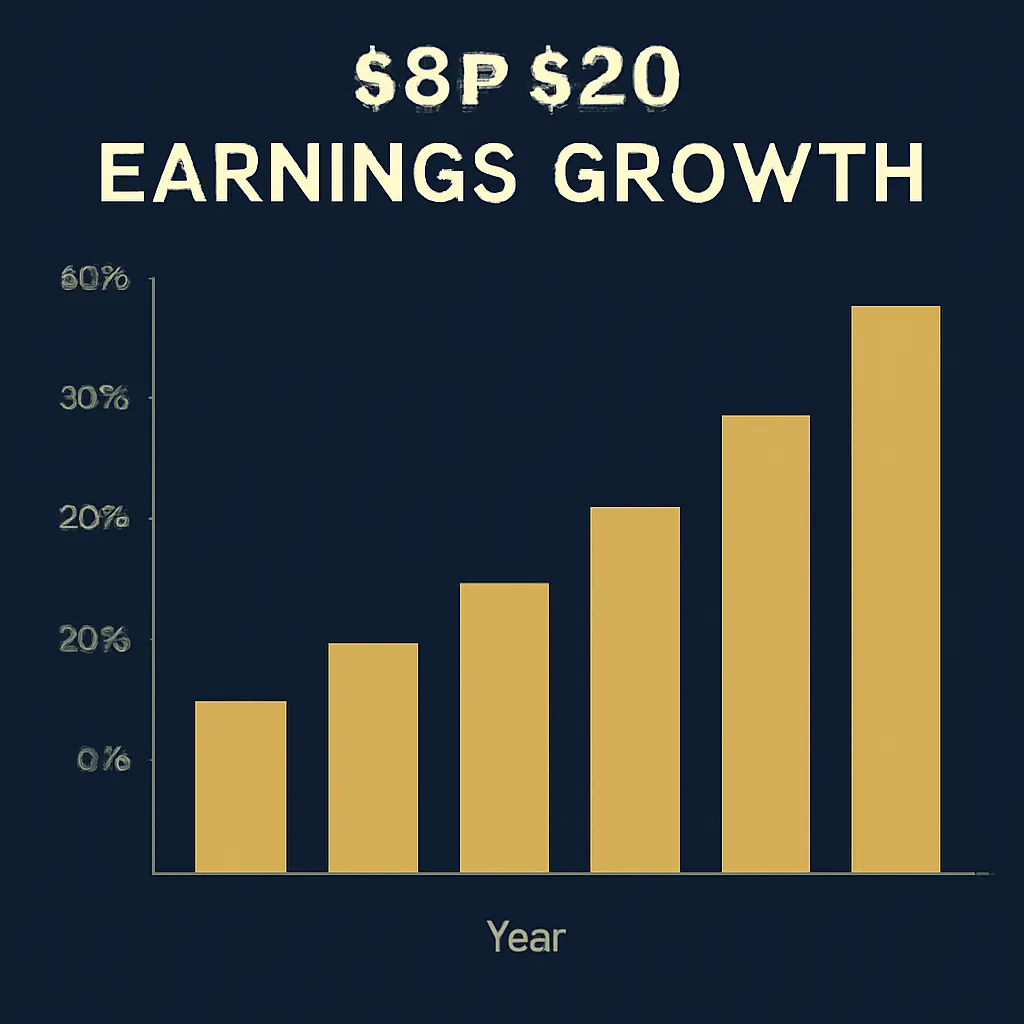
Roughly 88% of the S&P 500 companies that reported in the opening wave of the Q2 2026 earnings season beat Wall Street's profit forecasts — the highest share FactSet has recorded since it began tracking the data. Aggregate profits are up about 23% from a year earlier, the strongest growth in years. On almost any measure of corporate health, this is a blowout.
None of it is cheap.
The S&P 500's earnings yield — the flip side of its price-to-earnings ratio — sits near 4.6%, below its long-run average and barely above the 4.2% you can collect, essentially risk-free, from a 10-year Treasury. Strong profits and expensive stocks are not a contradiction in Q2 2026; they are the same story. Companies are minting cash, and investors have already bid the price of that cash up to a level that leaves little room for disappointment. The question for anyone putting money to work now is not whether the earnings are real. They are. It is whether you are being paid enough to own them.
The profits are genuinely strong — and broadening
Start with what the season actually showed. As of mid-July, with the major banks, several industrial heavyweights and a large slice of the technology complex having reported, FactSet put the blended year-over-year earnings growth rate at roughly 23%, with Reuters and Forbes confirming a similar 23–24% reading. The share of companies beating estimates — on both earnings and revenue — is running at a record-high 88%, well above the five-year average near 77%.
What makes this more than a one-quarter fluke is the breadth. For most of 2023 and 2024, the story ran the other way: a handful of megacap technology names carried the index while the other 493 companies collectively delivered flat or shrinking profits. Q2 2026 looks different. Financials posted double-digit growth on stronger trading revenue and resilient credit performance. Industrials are growing again as corporate capital spending picks up. Even the laggards of the prior cycle — much of the small- and mid-cap universe — are turning positive on easier year-over-year comparisons and stabilizing demand. The market's earnings engine is no longer a single cylinder.
That is the genuine good news, and it deserves to be stated plainly: the profit recovery is real, it is no longer confined to a few names, and it is being delivered by companies selling more and earning more — not by financial engineering or share buybacks masking weak operations.
The price is the problem
Strong earnings, though, are only half of a return. The other half is the price you paid for them, and on that front the market is asking a great deal.
The S&P 500 trades at roughly 22 times forward earnings, against a 25-year average closer to 18 and a longer-run historical norm nearer 16. Flip that ratio over and you get the earnings yield — about 4.6%, or what the index's profits amount to as a percentage of its price. Compare that to the 10-year Treasury yield near 4.2%, and the equity risk premium, the extra return investors demand for holding stocks instead of government bonds, compresses to roughly four-tenths of a percentage point. By the standards of the past two decades that is a notably thin cushion — though it is not as inverted as the late 1990s, when the earnings yield actually fell below the bond yield. The point is not that stocks are in a bubble. It is that investors are being offered a historically small amount of compensation for the risk of owning them.
Layered on top is the quality of those earnings. S&P 500 operating margins sit near record highs, which is another way of saying they have more room to fall than to rise. Margins are mean-reverting animals: labor costs drift up, pricing power fades, and the extraordinary efficiency gains of the past few years are already in the numbers. When you pay 22 times earnings for a market at peak profitability, you are implicitly betting that profitability keeps climbing from a level that is itself difficult to beat.
Wall Street's consensus for full-year 2026 S&P 500 earnings now sits near $270 per share, which is exactly how you arrive at a 22-times multiple at the index's current price. To justify paying up further, those estimates need to keep climbing — and sell-side estimates, as a rule, start the year high and drift down. This is the math the headline beat rate cannot fix. An 88% beat rate tells you companies are executing. It tells you nothing about whether the execution was already priced in. When a stock trades at 30 or 40 times earnings, beating the estimate is the expectation, not a surprise, and the penalty for missing rises accordingly.
What 1972 — and 1999 — actually teach
Investors reaching for historical reassurance often invoke Jeremy Siegel's work on the Nifty Fifty, the elite growth stocks that traded at astronomical multiples before the 1973–74 crash. The comforting version of the story holds that great companies bought at the 1972 peak eventually did fine. The accurate version is more demanding. Siegel's data, laid out in The Future for Investors, show that those celebrated growth stocks, purchased at their December 1972 peak, ultimately delivered returns roughly in line with the broader market over the following quarter-century — but only for investors who held on through a bear market that cut many of the names in half and pushed a few to the brink of collapse.
Siegel's conclusion was never that price does not matter. It was the stricter point that at a high multiple, the underlying growth has to actually exceed what everyone is already pricing in — and that the highest-multiple names of 1972 were precisely the ones that failed that test, while steadier businesses purchased at less extreme valuations carried the group. For an investor who can plausibly sit through a 50%-plus drawdown and wait a decade or more to be made whole, premium multiples for genuinely durable businesses can work out. For everyone else — which is most people — the practical lesson remains the one value investors have always preached: the price you pay sets the ceiling on your return. Howard Marks has made the same point more recently, warning that paying up for growth feels different only until the growth disappoints.
The cautionary parallel is closer in time. Entering 2000, the S&P's earnings yield dropped below the Treasury yield and Robert Shiller's cyclically adjusted price-to-earnings ratio hit what was then a record. The businesses, by and large, survived and went on to thrive. The returns did not: the index produced essentially flat total returns over the following decade. Strong companies, ruinous entry prices.
The Magnificent Seven, counted honestly
You cannot discuss Q2 valuations without talking about the Magnificent Seven — Apple, Microsoft, Nvidia, Alphabet, Amazon, Meta and Tesla — because they still account for a disproportionate share of the index's market value and an even larger share of its earnings growth. Counting them honestly matters more than the slogan.
Five of the seven are doing the heavy lifting. Nvidia, Meta, Alphabet, Amazon and Microsoft are delivering the bulk of the group's profit expansion, powered by cloud demand and the artificial-intelligence build-out. The four largest hyperscalers alone — Microsoft, Alphabet, Amazon and Meta — collectively guided to more than $300 billion in capital spending for 2025, the great majority of it AI infrastructure, according to Goldman Sachs, with 2026 tracking higher still. That spending is the reason the earnings are growing this fast, and it is also the reason the multiples are this high: investors are paying today for profits they expect the AI cycle to generate tomorrow.
The other two complicate the picture. Apple, the largest company in the group by reputation, is contributing modest, single-digit earnings growth, carried by its services franchise rather than devices; it is steady, but it is not an engine of the 23% headline. Tesla is the more pointed problem: its earnings have been erratic and its automotive margins compressed, so at current valuations it functions as a drag on the group's blended growth rather than a lift. The Magnificent Seven is, in practice, five growth engines, one steady hand, and one expensive question mark. Lumping them together flatters the laggards and undersells the leaders — which is exactly the kind of imprecision that matters when you are deciding what to pay.

What to actually do
None of this is a sell signal. The historical record is clear that expensive markets with genuinely strong earnings tend to produce mediocre, not catastrophic, forward returns — the slow drag of a high starting valuation rather than a cliff. But mediocre is not nothing, and it is not what a 23% growth rate tempts you to expect. A few principles hold up.
Respect the entry price. The single largest determinant of your long-term return is the multiple you start from, and right now that multiple is demanding. If you are adding to equities, scale in over time rather than chasing a market trading at 22 times earnings on the strength of a single blowout quarter. Time bails out a high entry price; a short horizon does not.
Treat the 23% as a peak, not a trend. Year-over-year comparisons get harder from here, the AI capex bill eventually has to be earned back, and profit margins — near record highs across much of the index — have more room to disappoint than to surprise. Underwriting 23% growth into the future is the kind of mistake that turns a great business into a poor investment.
Take the breadth seriously. The fact that earnings growth is finally spreading beyond a handful of megacaps is a constructive sign for the broad index and a reason to question the wisdom of a concentrated bet on the Magnificent Seven alone. Diversification here is not a hedge against ignorance; it is a response to where the growth is actually showing up.
Finally, weigh the alternative. With the 10-year Treasury near 4.2%, the opportunity cost of owning expensive equities is real for the first time in well over a decade. During the zero-rate years there was nowhere else to go; today there is. That does not mean abandoning stocks — it means the bar for what an expensive equity must deliver is genuinely higher, and a portion of the portfolio held in short-duration bonds or cash is no longer dead money dragging on returns.
The headline from Q2 2026 is true and worth saying plainly: corporate America is having one of its best earnings seasons on record. The footnote is the one that decides your return: you are being asked to pay a premium price for it. Strong profits do not protect you from a rich starting valuation — they just make the disappointment, if and when it comes, take longer to arrive. Price in the strength. Then price in the price.
The article shows the pattern. The app trains the response.
Continue in Tikva to turn the insight into a repeated response.
Open TikvaSources and review notes
Tikva separates educational content from medical, legal, investment, and personalized financial advice. Sensitive pages should be reviewed by qualified professionals before high-scale publication.