Key takeaways
- AI-related companies have added approximately $27 trillion in market value since late 2022—equivalent to 36% of total U.S. stock market value—yet Goldman Sachs warns investors may be overestimating how long growth can persist.
- OpenAI was privately valued at $852 billion in March 2026 and has committed an estimated $1.4 trillion to data center infrastructure over eight years, despite expecting no positive free cash flow in the foreseeable future.
- Global data center energy consumption, driven by AI workloads, is projected by the IEA to reach between 620 and 1,050 TWh by 2026—roughly equivalent to the annual electricity consumption of France.
- Hao's Empire of AI documents how the AI supply chain relies on workers in Kenya, the Philippines, and elsewhere earning under $2 per hour to filter graphic content, constituting what she terms a colonial extraction model.
- The AI industry's quasi-religious framing—centered on AGI and existential risk—functions to deflect scrutiny of present-day harms and justify extraordinary resource expenditure, Hao argues.
On July 24, 2026, Karen Hao sat down with Bloomberg to deliver a message the AI industry has spent three years trying to dismiss: the current model of artificial intelligence development is fundamentally, perhaps irreversibly, broken. The interview coincides with a moment when the market is finally asking the questions Hao has been posing since her days as the Wall Street Journal's first AI reporter—and before that, as a senior artificial intelligence reporter at MIT Technology Review, where she published a damning 2020 investigation into OpenAI's labor practices in Kenya.
Hao's new book, Empire of AI: Dreams and Nightmares in Sam Altman's OpenAI, published by Penguin Press in May 2026, has become the definitive critical text on the AI boom. But the Bloomberg interview landed at a particularly volatile moment. Goldman Sachs reported in June 2026 that AI-related companies have added roughly $27 trillion in market value since late 2022—equivalent to 36 percent of the entire U.S. stock market's value. OpenAI, the company at the center of Hao's reporting, was privately valued at $852 billion in March 2026 after raising $122 billion, with some secondary trades pushing implied valuations toward $965 billion. Yet the company expects to burn tens of billions annually and has committed an estimated $1.4 trillion to data center infrastructure over the next eight years with no projected timeline for positive free cash flow.
This is the reality TV part: the spectacle of valuations untethered from revenue, of CEOs promising artificial general intelligence while their companies hemorrhage cash. Hao's argument is that the spectacle is not a bug but a feature—a distraction from the extractive economics underneath.
The Trillion-Dollar Question Nobody Can Answer
The core of Hao's Bloomberg interview was a deceptively simple point: nobody has yet explained how the current generation of frontier AI models becomes a sustainable business. OpenAI's costs are staggering. A widely cited analysis from early 2026 estimated the company spends approximately $3.30 on compute, training, and inference for every dollar of revenue generated—a ratio that would be catastrophic in any other industry. The company's spending reset in February 2026, first reported by CNBC, trimmed projected 2030 capital expenditures from $1.4 trillion to roughly $600 billion, with revenue targets adjusted to around $280 billion. But as Hao noted in the interview, even these reduced numbers assume a tenfold revenue increase that no one has justified with concrete demand signals.
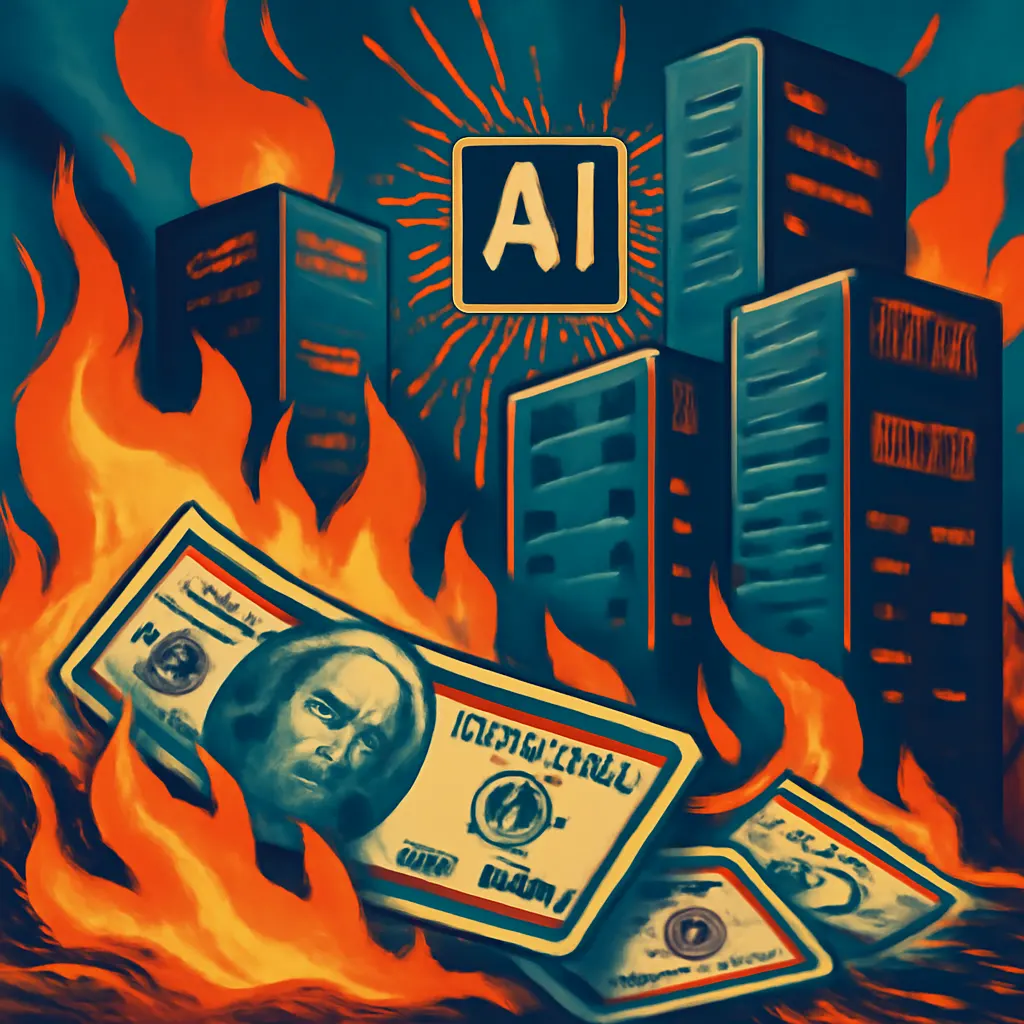
The problem isn't unique to OpenAI. Anthropic, xAI, and Google DeepMind are all operating at similar losses on their frontier model efforts. The entire industry is engaged in what Hao describes in Empire of AI as a “prestige arms race” in which companies compete on parameter counts and benchmark performance rather than on utility or profitability. The result is a market where the dominant players are incentivized to ship marginal improvements at enormous cost, then justify those costs with increasingly speculative promises about future capabilities.
The Atlantic reported in July 2026 that AI-linked firms have added $27 trillion in value over three years, an amount equivalent to roughly 100 percent of U.S. GDP. Goldman Sachs analysts noted that investors may be “overestimating how long above-average growth rates can persist.” Hao's warning is more pointed: the growth rates are a mirage built on infrastructure spending that has not yet been stress-tested by a downturn. The first real test—whether enterprise customers will continue paying premium prices for AI features when budgets tighten—is likely to arrive within the next 12 to 18 months as the current wave of pilot programs expires and companies evaluate actual returns.
The Colonial Architecture of AI Development
The most damning sections of Empire of AI, and the parts Hao emphasized in her Bloomberg conversation, concern what she calls the “colonial supply chain” of AI. The metaphor is deliberate. Just as European empires extracted raw materials from the Global South to fuel industrialization, AI companies extract human labor and data from the same regions to fuel model training. Hao's reporting, building on her earlier work at MIT Technology Review and the Wall Street Journal, documents how companies like OpenAI rely on tens of thousands of workers in Kenya, the Philippines, Venezuela, and Bangladesh to label data, filter toxic content, and train models through reinforcement learning from human feedback.
These workers, often paid less than $2 per hour, are exposed to graphic content—including depictions of violence, child sexual abuse material, and bestiality—for hours at a time. Hao's 2022 investigation for the Wall Street Journal, conducted with colleague Khari Johnson, revealed that OpenAI contracted with Sama, a San Francisco-based firm operating in Kenya, to filter violent and sexual content from training data. Workers reported post-traumatic stress, depression, and burnout. In Empire of AI, Hao extends this reporting, documenting how the trauma rippled outward from the content moderation centers into workers' families and communities.
“No one is asking whether this tech is actually helping people,” Hao told The Bureau of Investigative Journalism in May 2026. The Bloomberg interview reinforced this point: the human cost of AI development is not an externality to be managed. It is foundational to the current model. Without cheap, traumatized labor in the Global South, the models that generate hundreds of billions in valuation do not function. The economics are not broken. They are working exactly as designed—extracting value from the most vulnerable and concentrating it in the hands of a few.

The Power Problem
Then there is the literal power problem. AI development is an energy-intensive enterprise on a scale that strains comprehension. The International Energy Agency projects that global data center electricity consumption, driven primarily by AI workloads, will rise from approximately 460 terawatt-hours in 2022 to between 620 and 1,050 terawatt-hours by 2026. For context, the lower bound of that estimate is roughly equivalent to the entire annual electricity consumption of France. Goldman Sachs Research expects AI specifically to drive a 50 percent jump in global data center energy demand between 2023 and 2027, with a 165 percent increase by 2030.
In the United States, the grid is buckling. Data center construction is concentrated in a handful of regions—Northern Virginia, Texas, Arizona—where transmission infrastructure was designed for a fraction of current demand. Consumer Reports reported in 2026 that U.S. data centers' combined energy demand will nearly double between 2025 and 2028, with costs increasingly passed on to residential utility customers. The Department of Energy has expedited permitting for natural gas plants and even explored reopening retired coal facilities to meet the surge. Microsoft and Amazon have each committed to purchasing power from Three Mile Island and other nuclear sites, effectively privatizing portions of the civilian nuclear fleet for AI training.
Hao's argument, laid out in the Bloomberg interview, is that this resource consumption is not a temporary phase. It is structural. Larger models require exponentially more compute, which requires exponentially more power, which requires exponentially more infrastructure investment. The industry's response—more efficient chips, optimized training algorithms, smaller specialized models—has not meaningfully bent the demand curve. Total energy consumption continues to rise because efficiency gains are offset by increased scale. Jevons Paradox, familiar to anyone who has studied industrial economics, applies: making a resource cheaper to use increases total consumption.
The Religious Framing
One of the most provocative threads in Hao's analysis is her focus on what she calls the “religious framing” of AI. In interviews with NPR, Democracy Now, and now Bloomberg, she has argued that Silicon Valley's leaders have adopted a quasi-theological language—AGI, superintelligence, existential risk, the alignment problem—that functions as a shield against regulatory scrutiny and a justification for extraordinary resource expenditure. If you believe you are building a machine that will solve all human problems, then no cost is too high and no question about present-day harm is relevant.
This framing, Hao argues, is not incidental. It is the mechanism by which the industry deflects criticism. When workers in Kenya describe trauma from content moderation, the response from AI executives is that these are temporary growing pains on the road to a transformative technology. When energy consumption threatens grid stability, the response is that the end product will enable breakthroughs in fusion power and carbon capture. When valuations detach from revenue, the response is that traditional financial metrics do not apply to companies building the future. Each deferral relies on the same structure: present costs are real, but future benefits are infinite and therefore justify anything.
Hao's counterargument is direct: the future benefits are speculative, the present costs are concrete, and the people bearing the costs are not the people who will capture the benefits. This is not a technology problem. It is a governance problem.
What Comes Next
The Bloomberg interview ended with a question about alternatives. Hao's answer, expanded in the final chapters of Empire of AI, is that AI does not have to be built this way. Smaller, more efficient models trained on curated data rather than scraped internet exhaust can serve specific use cases at a fraction of the cost. Open-source efforts like Meta's Llama series and Mistral's models, while imperfect, demonstrate that frontier-level capabilities can be developed without the centralized resource extraction model. Regulatory frameworks—particularly the European Union's AI Act, which entered full enforcement in 2026—can impose transparency requirements that make the supply chain visible to consumers and regulators.

The market may force the issue before regulation does. Goldman Sachs noted in June 2026 that AI spending is projected to reach $765 billion in 2026 alone, rising to $1.6 trillion by 2031. At some point, the gap between spending and revenue becomes impossible to finance. OpenAI's IPO, anticipated for late 2026 or early 2027, will be the first real market test of whether public investors are willing to underwrite losses of this magnitude on the promise of future capabilities. The early signs are not encouraging: Barron's reported that OpenAI is already missing internal revenue targets, and institutional investors have begun quietly marking down their AI holdings.
Hao's warning is not that AI is inherently destructive. It is that the specific model of AI development that has won the current race—centralized, capital-intensive, extractive, and opaque—is unsustainable by any measure: financial, ecological, or social. The industry has been operating as if the laws of thermodynamics, economics, and political accountability do not apply. The next 18 months will determine whether that assumption was a strategic insight or a catastrophic miscalculation.
For now, the reality TV continues. But as Hao told Bloomberg, the credits are about to roll.
The article shows the pattern. The app trains the response.
Continue in Tikva to turn the insight into a repeated response.
Open TikvaSources and educational notice
This article is educational. It does not provide a medical diagnosis or replace guidance from a qualified health, legal, tax, investment, or financial professional. Decisions about your health or finances should consider your individual circumstances.
- Bloomberg — Karen Hao weekend interview on AI development economics and Empire of AI
- The Atlantic — Analysis of the $27 trillion AI stock market bubble and its systemic risks
- Goldman Sachs — Research on AI stock valuations and the $27 trillion market value increase since 2022
- International Energy Agency — Global data center electricity demand projections driven by AI
- The Bureau of Investigative Journalism — Interview with Karen Hao on AI's global power dynamics
- CNBC — OpenAI reduces spending commitments from $1.4T to $600B with revised revenue targets
FAQ
What is Karen Hao's main argument in Empire of AI?
Hao argues that the dominant model of AI development—centralized, capital-intensive, and reliant on extracting cheap labor and data from the Global South—functions like a modern colonial empire. She contends that this model is financially, ecologically, and socially unsustainable, and that Silicon Valley's religious framing of AGI serves to deflect scrutiny of these costs.
How much is OpenAI actually spending, and does the math work?
OpenAI committed approximately $1.4 trillion to data center infrastructure before revising estimates down to around $600 billion by 2030 in February 2026. The company generated $13.1 billion in revenue in 2025 but is projected to lose over $15 billion annually. Some analyses estimate the company spends roughly $3.30 for every dollar of revenue. No major AI lab has demonstrated a path to sustained profitability at current spending levels.
What are the energy implications of current AI development?
The IEA projects global data center electricity consumption will reach 620 to 1,050 TWh by 2026 due to AI workloads, comparable to France's total annual consumption. Goldman Sachs expects a 165% increase in data center energy demand by 2030. In the U.S., this is straining grid capacity in Virginia, Texas, and Arizona, with costs increasingly passed to residential consumers and prompting reopened coal plants and nuclear power deals.
What alternatives does Hao propose?
Hao points to smaller, more efficient models trained on curated data, open-source development models like Meta's Llama series, and regulatory frameworks such as the EU AI Act as evidence that AI can be developed differently. She emphasizes that the current centralized, extractive model is a choice, not a necessity, and that transparency requirements could expose the supply chain costs that companies currently hide.