Key takeaways
- Read the article, then choose one concrete next action.
- This content is educational and does not replace qualified medical, legal, or financial advice.
In the 2026 NAMI–Ipsos Workplace Mental Health Poll, 53 percent of US workers say they are burned out. Thirty-nine percent — nearly four in ten — say they are too overwhelmed to do their jobs. Not tired. Not in need of better self-care. Too overwhelmed to function in the role they were hired for.
Those numbers arrive in the middle of the largest “wellness” economy the world has ever built. The Global Wellness Institute put the global wellness economy at $6.8 trillion in 2024, on track for $9.8 trillion by 2029. On the surface, that is a paradox: never has so much money chased wellbeing, and never have so many workers been this depleted. It stops being a paradox the moment you separate two questions that employers keep collapsing into one. How are workers feeling? is not the same question as what is making the work itself unsustainable? The first funds meditation apps and resilience seminars. The second is the only one that moves the burnout number.
The number that should make employers flinch
The NAMI–Ipsos finding is not a vibes survey. It is a measure of operational capacity: more than half the workforce is running on empty, and roughly two in five cannot execute the job in front of them. The cost is not abstract. The McKinsey Health Institute’s 2022 analysis, Addressing Employee Burnout: Are You Solving the Right Problem?, identified toxic workplace behavior as the single biggest driver of negative outcomes — ahead of workload, ahead of any individual factor. Employees exposed to high levels of that behavior were eight times more likely to report burnout symptoms, and burned-out employees were three times more likely to say they intended to leave. Roughly one in four workers reports experiencing some form of toxic conduct on the job. That group is where the eight-times multiplier lives.
On the return side, two figures get quoted constantly, and they are not interchangeable. The World Health Organization’s much-cited four-to-one return — $4 in improved health and productivity for every $1 spent — comes from a 2016 Lancet Psychiatry analysis led by Dan Chisholm, Scaling-up Treatment of Depression and Anxiety: A Global Return on Investment Analysis. Read it carefully: it is an ROI for expanding treatment of common mental disorders generally, not a burnout figure and not a workplace-wellness figure. The workplace-specific number is more useful here. Deloitte’s Mental Health and Employers: The Case for Investment series has repeatedly found roughly £5 returned for every £1 employers put into mental-health support, with the return climbing higher for early, structured intervention. Either way the math is brutal in the other direction: every quarter an employer lets burnout run is a quarter it is paying for the problem and for the staff turnover it causes.

Wellness-washing is the $6.8 trillion distraction
Here is the trap. The Global Wellness Institute’s $6.8 trillion covers everything from thermal spas to boutique fitness to supplements — a sprawling consumer market that barely overlaps with the conditions of a job. The slice that is actually spent on workplace wellness programs is a rounding error by comparison: roughly $48.5 billion globally in 2020, according to GWI’s workplace wellness report, and concentrated in companies that already employ a sliver of the global workforce. The mismatch is the story. Employers buy the cheap, visible layer — the app, the speaker, the meditation room — because it photographs well and leaves the job design untouched. Researchers have a term for the gap between that surface and the reality underneath: wellness-washing. It is the corporate equivalent of serving a salad next to a structural defect and calling it a health initiative.
The reason it fails is mechanical, not moral. Burnout, as the World Health Organization formally classified it in 2019, is an occupational phenomenon driven by chronic workplace stress that has not been successfully managed. The stressor is the job. A breathing exercise does not change a deadline that was set without consulting the person who has to meet it.
The six places your job is actually breaking you
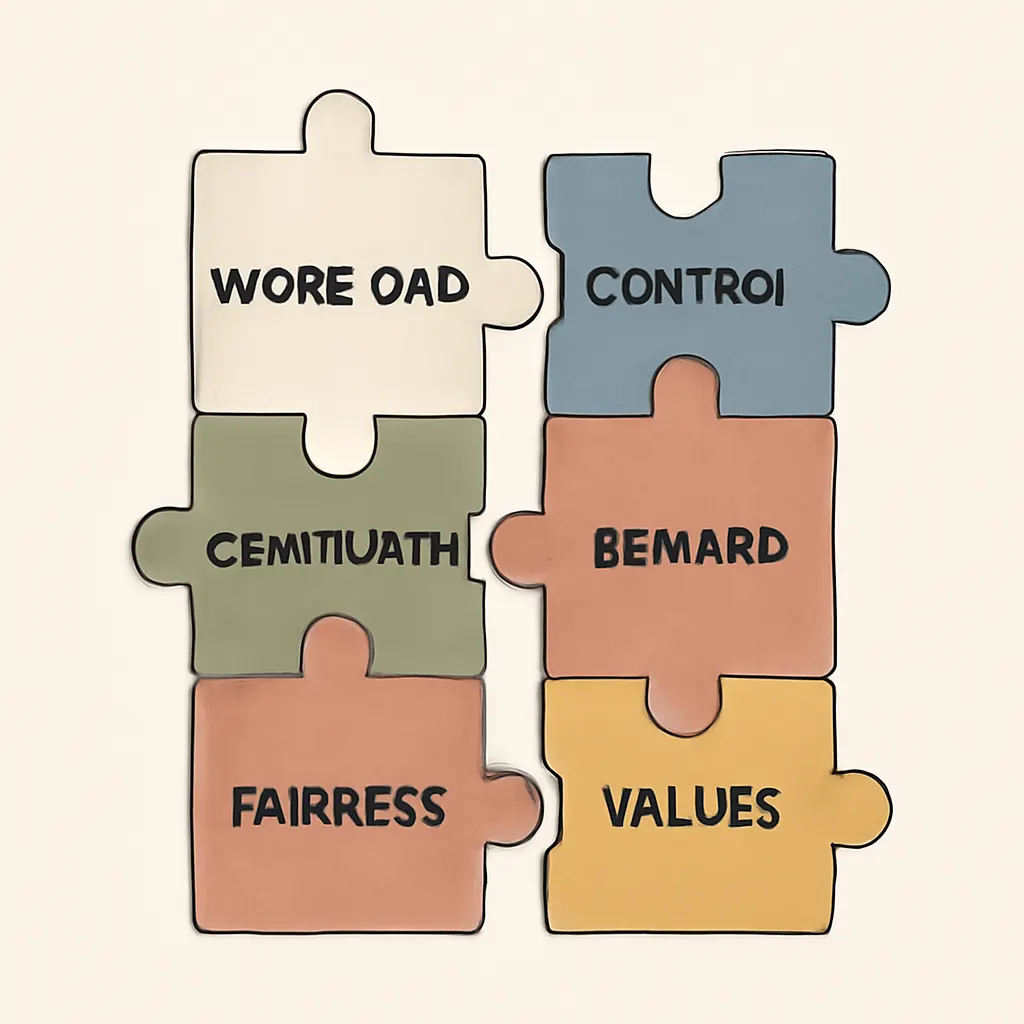
If you want to know whether a job will burn someone out, the most useful diagnostic is now roughly a quarter-century old. In the late 1990s the psychologists Christina Maslach and Michael Leiter built the Areas of Worklife model, later validated longitudinally in their 2008 study Early Predictors of Job Burnout and Engagement in the Journal of Applied Psychology. Their argument was simple and durable: burnout tracks a mismatch between a person and their job in six specific areas. You can run the audit on your own role in about ten minutes.
- Workload. Is the volume sustainable, or are you doing the job of one and a half people?
- Control. Do you have autonomy over how and when the work gets done, or are you micromanaged into exhaustion?
- Reward. Is there recognition — financial and otherwise — that matches what you deliver?
- Community. Are you buffered by decent colleagues and a competent manager, or isolated inside conflict?
- Fairness. Are decisions — pay, promotion, who gets the bad projects — made transparently and evenly?
- Values. Does what the organization actually does match what it claims to stand for?
The diagnostic is precise where vague self-care advice is not. Burnout is rarely about all six at once; it is usually two or three mismatches, of which workload is the most common and control the most corrosive. Name the mismatch and you have named the intervention.
What the evidence says actually works
Here is where the literature is unusually clear-eyed, and unusually unwelcome to anyone selling an app. A 2016 meta-analysis in The Lancet by the Mayo Clinic’s Tait Shanafelt and colleagues — Interventions to Prevent and Reduce Physician Burnout: A Systematic Review and Meta-Analysis — pooled randomized and controlled studies and found that organizational interventions, the ones that change the work itself, produced larger and more durable reductions in burnout than individual-focused ones. A companion review in JAMA Internal Medicine in 2017, led by Maria Panagioti, reached the same conclusion across controlled trials: structural change beat self-care, and the effects of individual programs faded fastest.
Meanwhile, the most rigorous look at what causes the damage points the same direction. In the systematic meta-review Can Work Make You Mentally Ill?, published in Occupational & Environmental Medicine in 2017 (Samuel Harvey and colleagues), the risk factors that consistently predicted common mental disorders were high job demands, role conflict, low autonomy, and weak social support. Those are the mismatches on the six-area list. They are not personality flaws and they are not fitness deficits. They are features of the job. Treating them as features of the worker is the original wellness-washing error.
So the hierarchy of evidence reads almost like a rebuke: the more an intervention changes the structure of the work, the more it helps; the more it asks the worker to adapt to a broken structure, the less it helps. Mindfulness and resilience training are not worthless — they can improve coping — but they sit at the bottom of the effect-size table, and they are the intervention of choice precisely because they are cheap to buy and invisible to operate.
Change the work, not the worker
The cleanest recent proof of what structural change buys came out of the United Kingdom. In 2022, the advocacy group 4 Day Week Global ran the largest controlled pilot of a shortened workweek to date — 61 companies, roughly 2,900 workers, six months at 100 percent of pay for 80 percent of the time — with researchers from Boston College and the University of Cambridge tracking outcomes. The peer-reviewed follow-up, published in 2025, confirmed what the headline numbers had said. Seventy-one percent of employees reported lower levels of burnout by the end. Stress fell. Sick days dropped by roughly two-thirds. Revenue held steady or rose, and 92 percent of participating companies said they would keep the schedule, with a meaningful share making it permanent — among them the affiliate-marketing firm Awin, which adopted the four-day week for all staff in 2023 after its own pilot.
Notice what the intervention actually did. It did not add a benefit. It removed a mismatch — the workload mismatch — and it returned a sliver of control to the worker. Two of the six areas, addressed structurally, moved the burnout number in a way that no app has ever moved it. That is the shape of a real solution.

What to do on Monday
For the individual worker reading the NAMI–Ipsos numbers and recognizing themselves, the leverage is diagnostic before it is therapeutic. Run the six-area audit honestly. Identify which two or three areas are mismatched, and put them in order of severity. Then translate each into a specific, falsifiable request: a reduction in concurrent projects, a shifted deadline, a clarification of role, a transparent explanation of how a promotion decision was made. Burnout thrives on vague distress; a named mismatch is a negotiable one, and a negotiable mismatch is a test of whether the employer will meet you.
For managers, the evidence is an instruction, not a suggestion. The highest-yield moves are the unglamorous ones: staff to the workload you have actually assigned, give people authority commensurate with their responsibility, enforce a single source of truth on priorities, and remove the toxic conduct that the McKinsey data shows driving the eight-times multiplier. Build the four-day pilot if you can. If you cannot, find the structural equivalent in your own shop.
And read the result honestly. A job that diagnoses as mismatched on five of six areas, and that responds to every request with a resilience webinar, is not a wellness problem. It is an exit signal. The point of the diagnostic is not to help you tolerate an abusive system more gracefully. It is to tell you, with some precision, where the work can be repaired — and where it cannot, so you stop treating exhaustion as a personal failing and start treating it as data.
More than half the workforce just told NAMI and Ipsos the same thing. The question was never whether the problem is real. It is who is willing to fix the job instead of rebranding the worker.
The article shows the pattern. The app trains the response.
Continue in Tikva to turn the insight into a repeated response.
Open TikvaSources and educational notice
This article is educational. It does not provide a medical diagnosis or replace guidance from a qualified health, legal, tax, investment, or financial professional. Decisions about your health or finances should consider your individual circumstances.