Key takeaways
- Nvidia, Apple, and Microsoft alone now represent over 18% of the S&P 500, with the top 10 stocks accounting for 38-43% of the entire index as of mid-2026.
- Apple's Q3 2026 revenue reached $109.4 billion (up 16% YoY), but roughly half the EPS beat came from a one-time $0.11 tariff refund, masking softer Services revenue.
- Meta's free cash flow collapsed from $8.55 billion to $784 million year over year as the company poured capital into AI infrastructure, triggering a 10% share decline.
- Cap-weighted S&P 500 ETFs like VOO now allocate approximately 35-40% to just five mega-cap tech stocks, undermining the diversification that index funds are supposed to provide.
- Mega-cap tech companies announced combined AI capital expenditure exceeding $725 billion for 2026, concentrating index fund exposure in companies spending record sums on unproven returns.
On the morning of July 31, 2026, retail investors logging into their brokerage accounts saw something they hadn't expected: their S&P 500 index funds were swinging 2-3% on the strength — or weakness — of a single afternoon's worth of corporate press releases. Microsoft shares jumped over 8%. Amazon climbed nearly 10%. Apple sank roughly 4%. And tens of millions of Americans holding plain-vanilla ETFs in their 401(k)s discovered, perhaps for the first time, that their "diversified" portfolios were effectively a leveraged bet on five technology conglomerates.
The closing of mega-cap tech earnings on July 31, 2026 wasn't just a milestone in the quarterly earnings cycle. It was the moment the structural flaw at the heart of passive investing became impossible to ignore. Nvidia, Apple, Microsoft, Amazon, and Alphabet now account for roughly 35-40% of the entire S&P 500 by market capitalization. When those five companies speak, the index moves. When they miss, the index falls. There is no diversification in a portfolio where four out of every ten dollars is parked in the same handful of tickers.
The Numbers Behind the Squeeze
Let's look at the actual composition of the most widely held index fund in America: the Vanguard S&P 500 ETF (VOO). As of mid-2026, its top holdings were Nvidia at approximately 7.5-7.9% of the fund, Apple at 6.6-7.0%, Microsoft at 4.3-5.1%, Amazon at 3.5%, and Alphabet's share classes combining for roughly 7%. Add in Meta Platforms at another 3-4%, and you have over 35% of a $1.3 trillion fund concentrated in six companies that all draw their growth from the same thematic engine: artificial intelligence infrastructure, cloud computing, and consumer hardware.
That concentration is not a historical accident. It is a mathematical inevitability of market-cap-weighted indexing. As Nvidia's market capitalization surged past $5 trillion in 2026 — making it the largest company in the world by a wide margin — every passive investor who bought VOO, SPY, IVV, or any comparable S&P 500 fund was automatically assigned an ever-larger allocation to the chipmaker. No portfolio manager made that decision. The index methodology did. And the index methodology is agnostic to valuation, risk, and common sense.
The result is a market structure that investment bank JP Morgan flagged in its Eye on the Market research: technology sector capital spending contributed 40-45% of US GDP growth over the last three quarters, up from less than 5% in prior periods. The entire economic narrative of 2026 — the AI buildout, the data center boom, the semiconductor surge — has been concentrated in a narrow band of mega-cap spenders. And because index funds weight by market cap, passive investors have been buying into that narrative at exactly the moment valuations have become most stretched.
What Q2 Earnings Actually Showed
The earnings reports released during the week ending July 31, 2026 told a story of extraordinary corporate performance — and extraordinary vulnerability. Apple posted quarterly revenue of $109.4 billion, up 16% year over year, a June quarter record. Net income reached $29.8 billion. Microsoft's free cash flow hit $19.6 billion, and its shares surged over 8% after the report as management framed AI capital expenditures as the benchmark for how to spend productively. Amazon jumped nearly 10% on its own strong results.
But the cracks were visible too. Apple's earnings beat was partially flattered by a one-time $0.11 per share tariff refund from the US government — excluding that, the surprise would have been roughly half as large. Services revenue of $30.7 billion came in slightly below analyst estimates of $31.2 billion. Meta's free cash flow collapsed from $8.55 billion a year earlier to just $784 million, and its shares dropped nearly 10% as investors questioned whether its AI investments would ever generate proportional returns. Alphabet's revenue of $116.9 billion beat estimates, but the company faced mounting regulatory pressure and rising infrastructure costs.
Here is the problem for passive investors: none of those nuances mattered for their portfolios. What mattered was the aggregate direction. When Microsoft and Amazon surged, they pulled the entire S&P 500 higher — regardless of what the other 495 companies were doing. When Apple and Meta disappointed, they dragged the index down. The index fund investor owned all of those outcomes, in proportion to market cap, with no ability to discriminate between them.
The Hidden Cost of "Diversification"
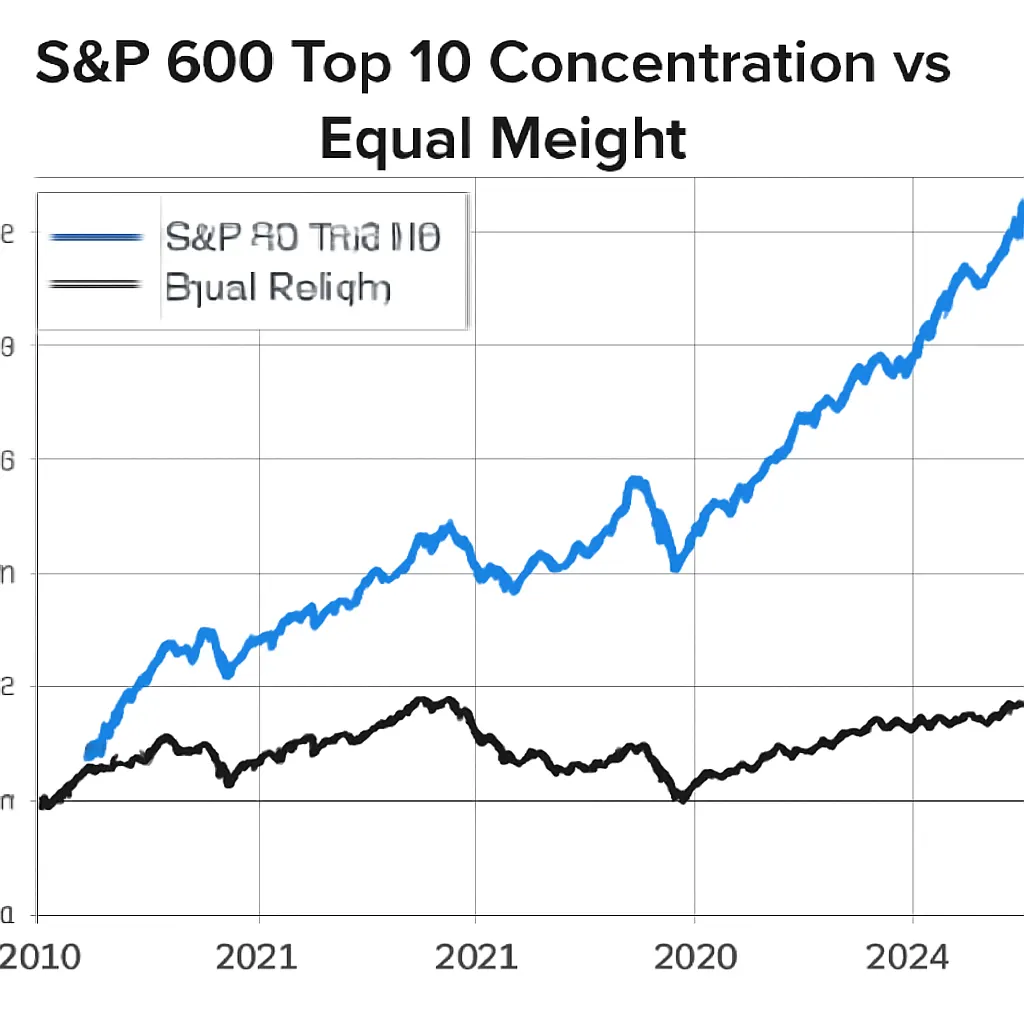
The central promise of index fund investing is diversification: by owning a broad swath of the market, you reduce idiosyncratic risk. That promise held for decades, when the S&P 500's top 10 stocks represented 20-25% of the index. It does not hold today. According to data compiled by Pensions & Investments and corroborated by multiple fund managers, the top 10 stocks in the S&P 500 now account for roughly 38-43% of the index's total weight. That is not diversification. That is a concentrated bet with extra steps.
The divergence between the cap-weighted S&P 500 and its equal-weighted counterpart tells the story starkly. The equal-weighted version — which assigns each of the 500 companies an identical 0.2% allocation — has historically outperformed the cap-weighted index by approximately 1.05% annually over long horizons, according to research from Invesco. But over the last five years, as mega-cap tech has dominated, the cap-weighted index has posted a total return of roughly 110% versus approximately 84% for the equal-weighted version. That outperformance has drawn even more capital into cap-weighted funds, which has further concentrated their holdings, which has driven more money into the same handful of stocks. It is a self-reinforcing cycle.
The risk is not theoretical. Risk.net, a financial risk management publication, noted in a 2026 analysis that passive funds now hold approximately $19 trillion in assets versus $16 trillion in active funds — a historic inversion that has concentrated market risk in ways the financial system has never experienced. When passive flows dominate, price discovery degrades. When passive flows reverse — during a correction, a recession, or a simple shift in sentiment — the selling pressure hits the most concentrated holdings hardest, because those are the positions that every fund owns in the largest size.
The Valuation Problem
There is a second, less-discussed dimension to the concentration risk: valuation. As of Q1 2026, the valuation gap between the cap-weighted and equal-weighted S&P 500 had widened dramatically, according to research from Aligné Wealth and S&P Dow Jones Indices. The cap-weighted index trades at a premium that reflects the outsized multiples investors have assigned to Nvidia, Microsoft, Apple, and the rest of the mega-cap cohort. The equal-weighted index, which gives equal billing to the 490 smaller companies, trades at a significant discount to historical averages.
What this means in practice: investors buying VOO or SPY today are paying a premium multiple for a concentrated basket of large-cap tech stocks, while the broader market — the actual diversification they think they are buying — remains reasonably valued. They are getting the most expensive part of the market at full weight, and the cheaper parts at negligible weight. That is the opposite of what most investors are trying to achieve.
The situation has grown acute enough that BlackRock, the world's largest asset manager, has launched products specifically designed to address it. The firm's TOPC ETF caps individual S&P 500 holdings at 3%, deliberately reining in mega-cap tech exposure. Russ Koesterich, a portfolio manager at BlackRock, has publicly argued that the technology sector's concentration in cap-weighted indices now represents a material risk that investors need to manage actively rather than passively accept.
The AI Spending Trap
The Q2 2026 earnings season crystallized another problem: the mega-cap technology companies are engaged in an unprecedented capital expenditure binge that is consuming their free cash flow at record rates. Amazon, Meta, Microsoft, and Alphabet collectively announced AI infrastructure spending plans exceeding $725 billion for 2026, according to Bloomberg data cited in earnings coverage. Meta's free cash flow collapse — from $8.55 billion to $784 million year over year — is the canary in the coal mine. The company is pouring capital into AI infrastructure faster than it can generate returns, and investors are beginning to ask whether the spending will ever pay off.
For passive investors, this creates a paradox. The same index funds that are concentrated in mega-cap tech are also concentrated in companies that are spending their cash flow on capital projects with uncertain payoffs. If AI investment delivers the returns that companies like Microsoft and Alphabet are promising, the concentration will be rewarded. If it does not — if the AI capex cycle turns out to be more dot-com bubble than infrastructure boom — then the same five companies that have driven the index higher will drive it lower, and there will be no diversification to cushion the fall.

Fortune magazine, reporting on the earnings season under the headline "Big Tech earnings slam into a market in revolt over AI spending," captured the tension precisely. The market is no longer rewarding AI investment uncritically. Meta's 10% post-earnings decline was a signal that investors are demanding proof of return, not just promises of future growth. But index fund investors cannot act on that signal. They own Meta at whatever weight the index assigns, and they will continue to own it regardless of whether the company's AI strategy makes economic sense.
What Investors Should Actually Do
The first step is honest assessment. If you hold a cap-weighted S&P 500 ETF as your core equity position, you are not diversified across the US economy. You are concentrated in five technology companies. That may be an acceptable risk — those companies are profitable, cash-generative, and dominant in their markets — but it should be a conscious choice, not an accident of index methodology.
The second step is considering structural alternatives. Equal-weight S&P 500 ETFs, such as the Invesco S&P 500 Equal Weight ETF (RSP), allocate identically across all 500 constituents, reducing single-stock concentration to 0.2% per holding. Capped-weight funds, like BlackRock's TOPC, limit individual positions to 3%, trimming the mega-cap tail. Factor-based or fundamentally weighted indices offer another approach, tilting toward value, quality, or dividend metrics rather than market cap alone.
The third step is recognizing that concentration cuts both ways. Over the last five years, cap-weighted concentration has produced extraordinary returns. Investors who abandoned mega-cap tech in 2023 or 2024 underperformed dramatically. The question is not whether concentration has worked — it has — but whether the conditions that made it work will persist. With Nvidia trading at a market capitalization exceeding $5 trillion, with Apple and Microsoft each worth over $4 trillion, and with AI capital expenditure running at $725 billion annually, the margin of safety is thinner than it has been in a generation.
The closing of Q2 2026 earnings on July 31 was not a crisis. Apple, Microsoft, Amazon, and Alphabet are not imploding. But the week exposed a structural truth that every investor should internalize: in a market where the top five stocks represent nearly 40% of the index, the word "diversified" has lost its meaning. A portfolio that rises and falls on the earnings reports of five companies is not a diversified portfolio. It is a thematic bet. And thematic bets, whatever their merits, should be made with open eyes.
The article shows the pattern. The app trains the response.
Continue in Tikva to turn the insight into a repeated response.
Open TikvaSources and educational notice
This article is educational. It does not provide a medical diagnosis or replace guidance from a qualified health, legal, tax, investment, or financial professional. Decisions about your health or finances should consider your individual circumstances.
- Apple Newsroom — Apple Q3 2026 earnings results confirming $109.4B revenue and 16% YoY growth
- CNBC — Apple Q3 2026 earnings live coverage with EPS and revenue analyst comparisons
- Investopedia — Microsoft and Meta Q2 2026 earnings results including free cash flow figures
- Risk.net — Passive fund assets reaching $19 trillion and concentration risk analysis
- Pensions & Investments — S&P 500 top 10 stock concentration data at 38.5%
- BlackRock — TOPC capped-weight ETF and Russ Koesterich on mega-cap concentration risk
FAQ
Why are S&P 500 index funds so concentrated in tech stocks?
S&P 500 index funds are market-cap-weighted, meaning the largest companies by market value automatically receive the largest allocations. With Nvidia worth over $5 trillion and Apple and Microsoft each exceeding $4 trillion, these companies dominate the index simply because of their size. As their valuations have risen, their weightings have increased, drawing more passive capital into the same stocks and creating a self-reinforcing concentration cycle.
How much of my S&P 500 ETF is actually in the top five tech companies?
As of mid-2026, Nvidia, Apple, Microsoft, Amazon, and Alphabet collectively account for approximately 35-40% of cap-weighted S&P 500 ETFs like VOO and SPY. Nvidia alone represents roughly 7.5-7.9% of VOO's holdings, Apple 6.6-7.0%, and Microsoft 4.3-5.1%. The top 10 stocks across the entire index represent 38-43% of total fund assets.
What are the alternatives to cap-weighted index funds for reducing concentration risk?
Equal-weight ETFs like the Invesco S&P 500 Equal Weight ETF (RSP) assign each of the 500 companies an identical 0.2% allocation. Capped-weight funds, such as BlackRock's TOPC, limit individual holdings to 3%. Fundamentally weighted or factor-based indices tilt toward value, quality, or dividend metrics instead of market cap. Each approach trades some exposure to mega-cap growth for broader diversification across smaller and mid-sized companies.
Is concentration risk a reason to sell my index fund?
Not necessarily. Concentration has driven extraordinary returns over the last five years, with the cap-weighted S&P 500 returning roughly 110% versus 84% for the equal-weighted version. The question is whether the conditions that rewarded concentration will persist. Investors should assess their risk tolerance, consider adding complementary positions in equal-weight or small-cap funds, and make a conscious decision about how much exposure they want to the mega-cap tech trade.