Key takeaways
- Eat 20-40g of protein about 45 minutes before strength training; a 2025 meta-analysis of 21 RCTs found pre-exercise whey raised muscle protein synthesis up to 2.5-fold.
- The same dose taken immediately after exercise raised MPS 1.3-1.6-fold — effective, but a smaller spike than the pre-lift dose.
- Use one 25g whey scoop as the simple dose, or 0.35-0.4g per kg of body weight for the precise middle of the range.
- The anabolic window is real but short: AKT/mTOR signaling peaks 1-2 hours after training and declines by 4-5 hours.
- Total daily protein (~1.4-2.0g per kg) beats timing; a 2025 head-to-head meta-analysis found no lean-mass difference between pre- and post-training intake over 4+ weeks.
Protein before or after workout? The evidence now favors before. Eat 20-40g of protein about 45 minutes before your strength session: a 2025 meta-analysis of 21 randomized controlled trials found the pre-exercise dose produced a larger muscle-protein-synthesis (MPS) spike than the same dose after lifting — up to 2.5x versus 1.3-1.6x. Total daily protein remains the bigger priority.
For two decades, the default play in every gym has been the post-workout shake — chugging protein within an hour of your last rep, as if the muscle would close its doors without it. That instinct isn't wrong. It's just incomplete.
The newer evidence points the other way: what you take in before you lift sets up the muscle-protein-synthesis response that the training stimulus then amplifies. In the largest recent pooled analysis of whey timing, the pre-lift dose produced the biggest MPS response in the review — while the classic post-exercise protocol, effective but consistently smaller, looked like the backup play rather than the starting one.
Protein Before or After Workout? The Science Says Pre-Lift Whey Wins
The most detailed answer to date comes from a 2025 systematic review and meta-analysis in Nutrients, which pooled 21 randomized controlled trials — 371 healthy adults, every outcome confirmed by muscle biopsy — on whey protein combined with exercise and the AKT/mTOR pathway, the molecular machinery that drives muscle protein synthesis.
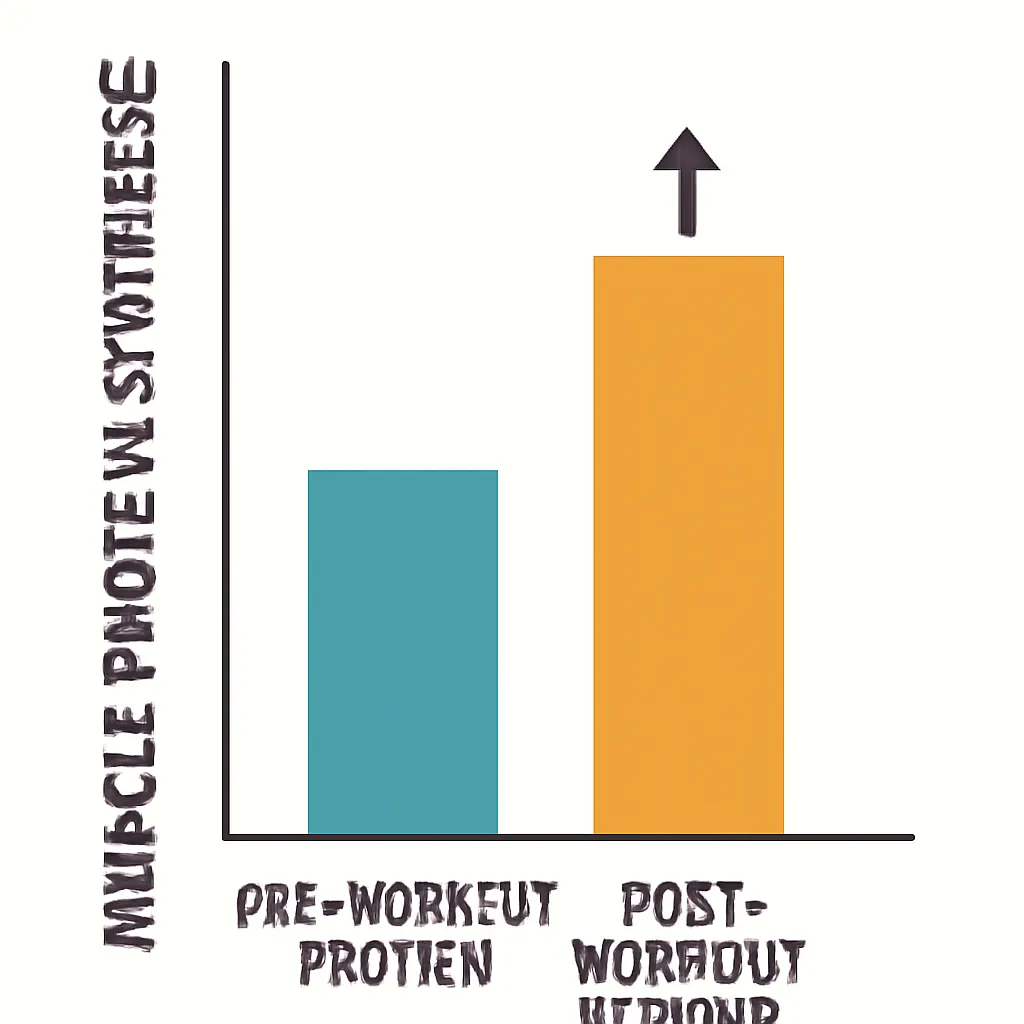
Here is the comparison that matters: in the pooled RCTs, the pre-exercise dose produced a larger MPS spike than the same dose taken after exercise. Consuming whey immediately after training raised myofibrillar fractional synthetic rate (FSR, the lab measure of MPS) by 1.3-1.6-fold over placebo. Taking whey 45 minutes before multiple-set resistance exercise pushed FSR up to 2.5-fold — the largest effect in the entire review.
One honesty note: that 2.5-fold ceiling came from a specific high-volume protocol (eight sets of ten leg extensions at 80% of one-rep max), and the review flagged substantial heterogeneity across studies — doses ranged from 10g to 60g, protocols varied widely, and the sample skewed heavily male. The overall pooled effect across all 15 quantitative studies stayed significant and large (Hedges' g = 1.24; 95% CI 0.71-1.77, p < 0.001). Treat 2.5x as the ceiling, not the guarantee. Read the full meta-analysis.
How Long Before a Workout Should I Eat Protein? The 45-Minute Rule
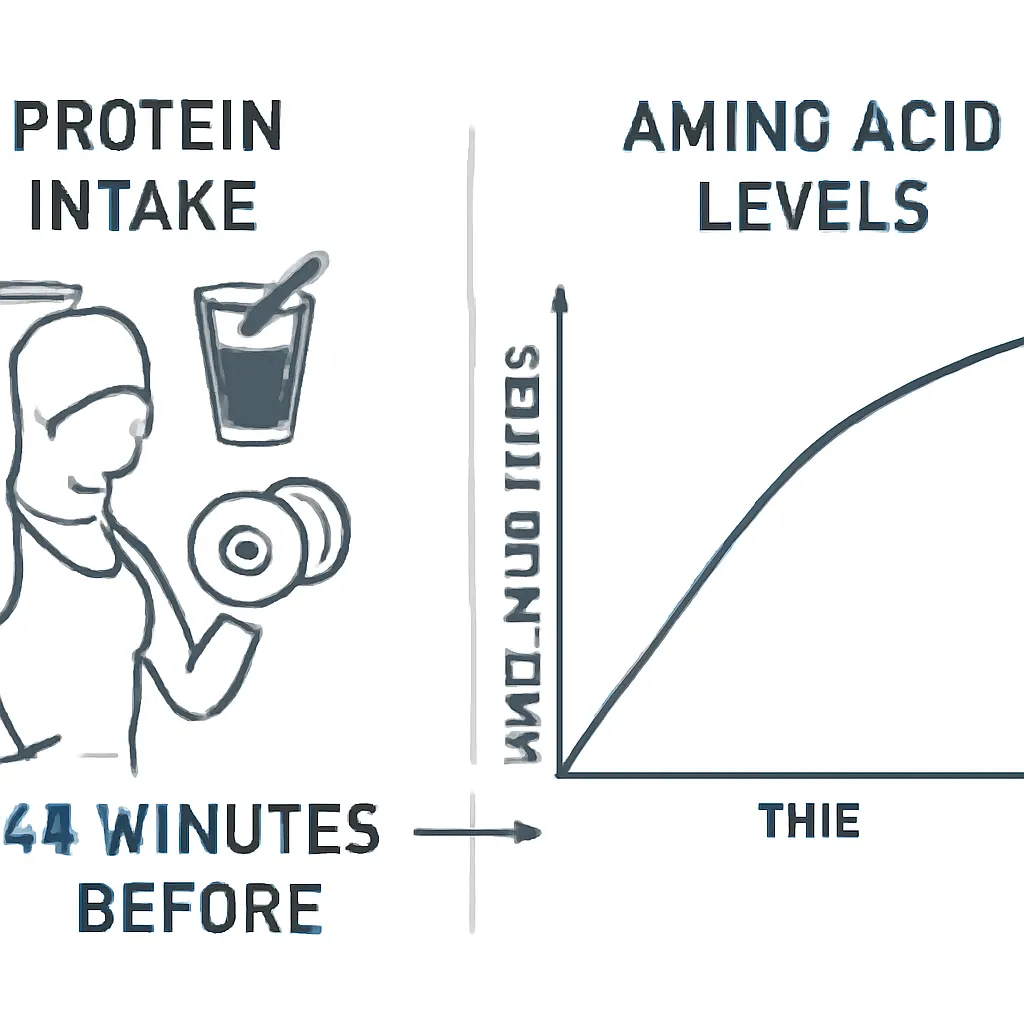
Eat your pre-lift protein roughly 45 minutes before the first set. That interval isn't pulled from nowhere — it's the timing used in the trials that produced the largest FSR responses, and it matches how whey actually behaves in the body.
Whey digests fast. Blood amino acids start rising within 30 minutes of ingestion and reach high levels roughly 100 minutes after, with leucine leading the charge. Leucine is the amino acid that directly triggers the mTOR signaling pathway that switches on MPS. Start 45 minutes out and those amino acids are climbing during your warm-up and staying elevated through your working sets — exactly when the muscle is being loaded.
If a shake that close to training unsettles your stomach, back it off to 60-75 minutes or use a lighter serving. Whole-food protein needs more room, so treat solids as a 1-2 hour pre-workout meal.
How Much Protein Should You Eat Before a Workout?
Aim for 20-40g before your session — the exact range the meta-analysis authors recommend for enhancing myofibrillar FSR and activating the AKT/mTOR pathway. Within that range, the review found a clear dose-response: roughly 10g produced about a 1.2-fold FSR rise, 20g about 1.4-fold, and 40g about 1.5-fold, with diminishing returns beyond that.
For the true middle of the range, use 0.35-0.4g per kg of body weight — about 24-28g for a 70kg person. The simplest practical dose: one 25g scoop of whey. That single serving delivers the leucine trigger and the total protein in one step, no scale required.
Context adjusts the dose. If you train fasted or went 4+ hours without protein, use the upper end. If you had a high-protein meal within the previous two hours, the lower end is plenty — the pre-lift dose tops up circulating amino acids.
Is a Protein Shake Before or After a Workout Better for Muscle Growth?
For acute muscle protein synthesis, before wins in this evidence. For lean mass gained over months, the difference mostly disappears — and that's exactly what you'd expect from honest science.
A separate 2025 meta-analysis (Casuso & Goossens) included only head-to-head randomized trials where one group took protein before every training session and another after, for at least four weeks. Across five trials: no meaningful difference in lean mass (SMD -0.08), no difference in chest press strength, and a small apparent advantage for pre-training protein in leg press that did not survive subgroup analysis (p = 0.07).
This doesn't contradict the pre-lift finding — it puts it in proportion. If you're already hitting your daily protein target, moving a portion of it to 45 minutes before training is a refinement with plausible upside and no downside. If you're under-eating protein, no amount of timing rescues that — total daily intake (consistently ~1.4-2.0g per kg of body weight) is the bigger priority in both reviews.
Is the Anabolic Window a Myth?
The anabolic window is real, narrow, and widely overstated. After a hard session, MPS rises above baseline for a limited period: the meta-analysis found the AKT/mTOR signaling cascade most active one to two hours after training, then noticeably declined by four to five hours. That's a genuine window — and it's shorter than the old "two hours or you lose it" dogma implied.
The myth isn't that the window exists. It's that the window is urgent, fragile, and more important than the day's total intake. In the head-to-head trials, people who took protein hours before training gained just as much lean mass as people who took it within minutes after. The window matters most in specific situations: training fasted, going 4+ hours without a meal, or older adults with higher per-meal leucine needs.
Practical translation: eat protein within a few hours around training — before, after, or both — and stop treating the post-gym shake as a race against the clock.
What to Do This Week
One lever, applied for seven days:
- Set your daily target at roughly 1.6-2.0g of protein per kg of body weight (about 0.7-0.9g per pound), spread across three to five meals.
- On training days, set out one serving — a 25g whey scoop, about 100g of cooked chicken breast, or 250g of plain Greek yogurt — to take 45 minutes before you lift.
- Keep the post-workout meal normal: eat within a few hours after, but drop the deadline mentality.
- If you train fasted or went 4+ hours without protein, make the pre-lift dose non-negotiable.
- Reassess after a week. If your stomach tolerates it, sessions feel fueled, and recovery is steady, make it a habit.
If you're pregnant, managing a medical condition, or taking medication (including GLP-1 drugs), check with your clinician before making significant dietary changes.
The article shows the pattern. The app trains the response.
Continue in Tikva to turn the insight into a repeated response.
Open TikvaSources and educational notice
This article is educational. It does not provide a medical diagnosis or replace guidance from a qualified health, legal, tax, investment, or financial professional. Decisions about your health or finances should consider your individual circumstances.
- Ji et al., Nutrients 2025 — the 21-RCT meta-analysis on whey protein timing, muscle protein synthesis and the AKT/mTOR pathway
- NutraIngredients, September 2025 — independent report on the same meta-analysis and its 20-40g pre-exercise recommendation
- Casuso & Goossens, Nutrients 2025 — head-to-head meta-analysis of protein timing on strength and lean mass (PMID 40647175)
- Casuso & Goossens, Nutrients 2025 — full text of the pre- vs post-training protein timing meta-analysis
- JoVE visualization of PMID 40871607 — the 2025 whey protein and MPS meta-analysis
FAQ
Should I eat protein before or after a workout?
Yes — and the evidence now favors before. Eating 20-40g of protein about 45 minutes before strength training produced a larger muscle-protein-synthesis spike (up to 2.5x) than the same dose immediately after exercise (1.3-1.6x) in a 2025 meta-analysis of 21 RCTs. Hitting your total daily protein target remains the bigger priority.
How long before a workout should I eat protein?
Take it about 45 minutes before your first set. That's the interval used in the trials that produced the largest MPS responses, and it matches whey's digestion speed — amino acids start rising within 30 minutes and stay elevated through your session. Solid meals need more room, so eat those 1-2 hours before.
Is a protein shake before or after a workout better for muscle growth?
For acute muscle protein synthesis, before wins. For lean mass gained over months, a 2025 meta-analysis of five head-to-head trials found no meaningful difference between pre- and post-training shakes — chest press and lean mass matched, and a small leg press advantage for pre-training protein didn't survive subgroup analysis.
How much protein should I eat before a workout?
Eat 20-40g of protein before your session, or 0.35-0.4g per kg of body weight for the precise middle of the range. One 25g whey scoop is the simplest practical dose. If you've gone 4+ hours without protein, aim for the upper end of the range.
Is the anabolic window a myth?
Partly. The window is real — muscle-protein-synthesis signaling peaks 1-2 hours after training and declines by 4-5 hours — but it's less urgent than the old "two hours or you lose it" dogma claimed. Head-to-head trials found equal lean mass gains from pre- and post-training protein when daily intake matched.