Key takeaways
- Eating 10 g of fiber or 10 g of protein ten minutes before white rice lowered the post-meal glucose spike in 23 of 32 and 22 of 32 people in a 2025 Nature Medicine Stanford study.
- A 2025 randomized crossover trial (Nutrients) using a vegetables-then-protein-then-carbs order cut time above 7.8 mmol/L blood sugar from 4.2% to 1.4%.
- Fat delayed the glucose peak but didn't shrink it — so fiber and protein, not a fatty starter, do the flattening work.
- Food order supports weight loss by blunting craving-driving glucose dips; realistic fat loss remains about 0.5–1% of body weight per week.
- Benefits were smaller in insulin-resistant or prediabetic people; check with a clinician before changing meal patterns if you have a medical condition or take medication, including GLP-1s.
Yes — you should eat vegetables before carbs. Start every meal with vegetables and protein, finish with the carbohydrates, and a 2025 Stanford study in Nature Medicine shows you'll blunt the post-meal blood sugar spike without cutting a single food. Eating 10 g of fiber or protein before white rice lowered the glucose rise, and a 2025 randomized trial cut time above normal blood sugar from 4.2% to 1.4%.
That's today's one-lever tip: not a diet plan and not a calorie recount — just a sequence. Take the same plate you'd normally eat and eat it in a different order. The food is identical; the glucose curve is not.
Should You Eat Vegetables Before Carbs?
Yes — and the strongest evidence to date comes from Stanford Medicine, published in Nature Medicine on June 4, 2025. The team put continuous glucose monitors on 55 adults with no history of type 2 diabetes and had them eat same-sized portions of seven carbohydrate foods: jasmine rice, buttermilk bread, shredded potato, pasta, canned black beans, grapes, and a mixed-berry bowl. Just under half — 26 of the 55 — turned out to have prediabetes, in line with the roughly one in three U.S. adults who have it. Participants ate each food first thing in the morning after a 10–12 hour fast, and each food twice, with glucose tracked for three hours after the meal.
The study had two parts: a precision map of how the same foods spike different people, and the order test. The first part showed why one-size-fits-all advice to eat less rice fails — blood sugar responses are highly individual. The second part tested the lever that works for most people regardless: what you eat first.
Rice produced the highest glucose spike on average, so the researchers used it as the test meal. In a follow-up with 32 participants, each person ate 10 g of fiber (pea fiber), 10 g of protein (boiled egg white), or 15 g of fat (crème fraîche) ten minutes before a 50 g portion of white rice while wearing a continuous glucose monitor.
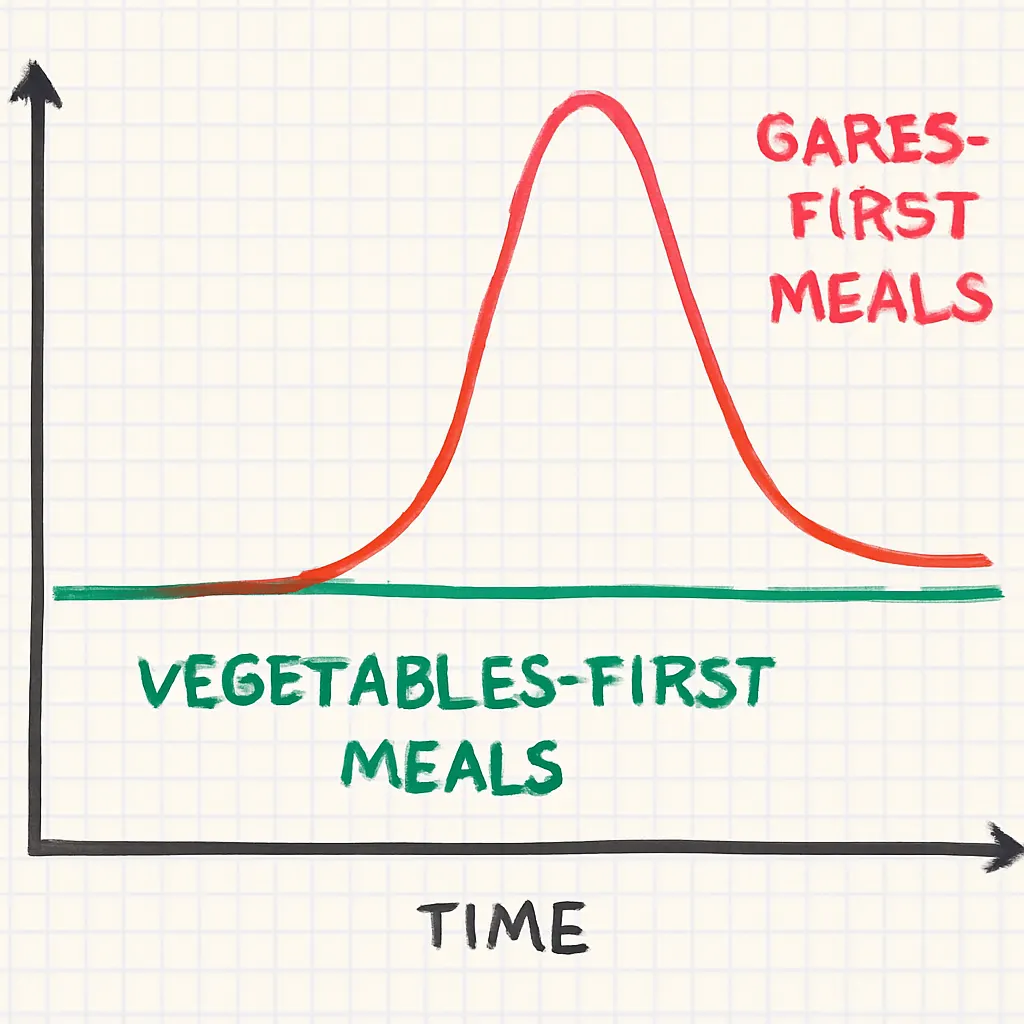
The results were consistent: fiber lowered the post-rice glucose spike in 23 of 32 people, protein in 22 of 32, and fat in 20 of 32. Fat mostly didn't shrink the spike — it pushed the peak later. Fiber and protein did both: a smaller spike, reached more slowly.
Lead author Michael Snyder, PhD, professor of genetics at Stanford Medicine, put it plainly: “Eating carbohydrates later in a meal is still a good idea... Eat your salad or hamburger before your French fries.”
That finding was repeated in a 2025 randomized crossover trial published in Nutrients, which tested the exact sequence people search for — vegetables first, protein second, carbohydrates last — in 18 healthy young women wearing glucose monitors. Mean blood sugar fluctuation (MAGE) fell from 3.49 to 2.56 mmol/L, and time spent above the 7.8 mmol/L blood-sugar target dropped from 4.2% to 1.4%. That's roughly a two-thirds cut in elevated time, with the same food in the same amounts.
Why bother flattening spikes at all? Postprandial glycemic responses — the size and speed of your glucose rise after meals — are linked to type 2 diabetes and cardiovascular disease risk, the Stanford authors note. Every spike is a demand for insulin; over time, chronically high demand on the beta cells that produce insulin is part of how prediabetes advances. Smaller, slower rises are the metabolic pattern you want, meal after meal.
Why Food Order Works — and What Most People Get Wrong
The mechanism is physical, not mystical. Fiber and protein slow gastric emptying — the rate your stomach releases food into the small intestine — so the glucose in your carbs reaches the bloodstream as a trickle instead of a surge. A slower, smaller rise needs less insulin, which means less rebound hunger when glucose drifts back down.
Independent evidence backs this. A 2025 systematic review of meal-sequence research, which screened 2,442 records published between January 2015 and March 2025 and included six studies with 107 participants, concluded that eating vegetables, fruit, or protein-rich foods before carbohydrate-rich foods consistently reduced postprandial glucose and the incremental area under the glucose curve compared with carb-first or mixed meals.
Here's what most people get wrong. First, food order doesn't delete calories. If you finish the salad and then double your rice portion, you've undone the benefit — the win is a flatter curve, not a free pass. Second, the effect is strongest in metabolically healthy people; in the Stanford trial, participants with insulin resistance or prediabetes saw smaller benefits, though fiber and protein still helped. Third, don't turn the plate into a stress test. If vegetables and protein come first and carbs last in roughly the right order, you've captured most of the effect. Perfection isn't required.
Fourth, the fat finding deserves attention. In the Stanford trial, 15 g of fat didn't lower the spike's height — it only delayed the peak. A drizzle of olive oil on your salad is still a good idea, but don't expect a fatty appetizer to flatten your glucose the way fiber and protein do. Food order is one input in a system that also includes total intake, protein amount, sleep, stress, and movement — it won't rescue a diet that's broken elsewhere.
Does Food Order Matter for Weight Loss?
Yes — indirectly, and the link runs through cravings. A glucose spike is followed by a reactive dip, and that dip is what produces the 3 p.m. vending-machine urge and the 10 p.m. kitchen raid. Flatten the spike and you blunt the craving, which makes it easier to hold a calorie deficit without fighting your own appetite. Spikes and crashes also leave you more likely to snack between meals, which is exactly how glucose instability shows up on the scale over months.
That's the honest case for food order for weight loss: it doesn't burn extra calories, it makes the deficit easier to maintain. Realistic fat loss runs at roughly 0.5–1% of body weight per week, and stable glucose is one of the best tools for keeping appetite from sabotaging that rate. The 2025 randomized trial found the strongest glucose improvements in metabolically healthy young women; people with insulin resistance get a smaller, though still measurable, benefit.
You can test the effect on yourself this week. Eat a normal dinner of rice, chicken, and broccoli with the rice first on Monday, then eat the identical meal with the broccoli and chicken first on Tuesday. Keep the portions identical. If you feel less foggy and less snacky after the second version, you've just measured the food-order effect on your own body.
What Order Should I Eat My Food To Lose Weight?
Three moves, same plate: vegetables first, protein second, carbs last. That's the order tested in the 2025 trial, and it maps directly onto a normal dinner:
- Vegetables first. Salad, greens, broccoli, roasted peppers — any fiber-rich produce. This is your 10 g of fiber delivered as real food.
- Protein second. Chicken, fish, eggs, tofu, or beans — the component that slows gastric emptying and does the heavy lifting on fullness.
- Carbs last. Rice, potatoes, pasta, bread, or fruit. You still eat them; you just eat them at the end.
Don't redesign your cooking around the rule. Put all three on the plate and simply take bites in that order. In the Stanford trial the pre-load window was ten minutes; in real life, finishing the vegetables and protein before touching the rice achieves the same thing.
Eating out, it's even simpler. Order the salad or a vegetable side as the starter, keep the protein as the main, and leave the fries until you've eaten both. If you want the bread basket, it goes last. That's the eat-salad-before-carbs-to-lose-weight advice in its most practical form — and it costs nothing extra.
One honest limit: protein and vegetables are the two components doing the work. If you skip the vegetables and only move the protein earlier, you lose part of the effect. And if you're insulin-resistant or prediabetic, treat food order as helpful — not as a replacement for the rest of your care. The systematic review's participants were young healthy adults aged 20 to 36.7, so treat the effect sizes with that in mind.
What To Do This Week
Apply it to the next three meals, not the next 30. Lunch: salad first, chicken second, roll last. Dinner: greens first, steak second, potatoes last. Breakfast: eggs or plain Greek yogurt first, fruit or toast last.
Then watch between meals. If the mid-afternoon slump and the late-night snack drive get quieter by day three, that's your signal the rule is working for your body. Keep it, and expand it to more meals once it stops being something you have to remember.
Troubleshooting: if you still hit an afternoon slump, check the size of the carb portion rather than the order — a plate that's half rice will spike no matter the sequence. And if there's no vegetable option when you're eating out, choose the protein-first route alone; in the Stanford trial it captured most of the benefit. If a heavy-carb meal is coming up — pasta night, a rice bowl, a sandwich lunch — the rule matters most then, because bigger carb loads produce bigger spikes.
One caveat: if you have diabetes or prediabetes, are pregnant, or take medication — including GLP-1 drugs — check with your clinician before changing meal patterns, because food order can shift your glucose and therefore your medication needs.
Food order is the rare nutrition tip that demands no willpower and removes nothing from your plate. Vegetables first, protein second, carbs last. Same meal, flatter curve, fewer cravings. Start tonight.
The article shows the pattern. The app trains the response.
Continue in Tikva to turn the insight into a repeated response.
Open TikvaSources and educational notice
This article is educational. It does not provide a medical diagnosis or replace guidance from a qualified health, legal, tax, investment, or financial professional. Decisions about your health or finances should consider your individual circumstances.
- Nature Medicine — the 2025 Stanford study on food order, fiber/protein pre-loads and glucose spikes
- Stanford Report — study methods: 55 participants, seven carbohydrate foods, mitigation test results
- PubMed — the 2025 randomized crossover trial on vegetables-first, protein, carbs-last order
- KCI — 2025 systematic review of meal-sequence effects on blood glucose (6 studies, 107 participants)
- Labmate Online — coverage of the Stanford blood-glucose and carbohydrate research
FAQ
Does eating vegetables before carbs lower blood sugar?
Yes. In a 2025 Nature Medicine study from Stanford, 10 g of fiber eaten ten minutes before white rice lowered the post-meal glucose spike in 23 of 32 people. A 2025 randomized trial found a vegetables-first order cut time above 7.8 mmol/L from 4.2% to 1.4%. The effect was smaller in insulin-resistant participants.
What order should I eat my food to lose weight?
Vegetables first, protein second, carbohydrates last. That sequence, tested in a 2025 randomized crossover trial, flattened glucose peaks and reduced time above the blood-sugar target range. It supports weight loss by blunting the cravings that follow glucose spikes. Realistic fat loss stays at about 0.5–1% of body weight per week.
Does eating protein before carbs help control blood sugar?
Yes. In the 2025 Stanford study, 10 g of protein (boiled egg white) eaten ten minutes before rice reduced the glucose spike in 22 of 32 people. Protein slows gastric emptying, so carbohydrate glucose reaches the blood more gradually. Fat, by comparison, only delayed the peak rather than lowering it.
Is it better to eat vegetables before or after carbohydrates?
Before. Vegetables first deliver fiber that slows gastric emptying and blunts the glucose spike, which is why studies test a vegetables-then-protein-then-carbs order. Eating vegetables after carbs still provides fiber, but the spike has already started. The evidence consistently favors vegetables and protein before, carbs last.
Does the order you eat food affect weight loss?
Yes, indirectly. Food order flattens glucose spikes and reduces the reactive dips that trigger cravings, making a calorie deficit easier to hold. It doesn't cancel calories, so portions still count. The 2025 evidence shows the clearest glucose benefits in metabolically healthy people, with smaller effects in insulin resistance.